May 02, 2011

FILM REVIEW


Lavoura Arcaica
(To the Left of the Father) (2001)


* Director:
* Luiz Fernando Carvalho
* Writers:
* Luiz Fernando Carvalho, Raduan Nassar

* Actors:
* Selton Mello,
* Raul Cortez,
* Juliana Carneiro da Cunha,
* Simone Spoladore,
* Leonardo Medeiros


This poignant universal story,adapted after Raduan Nassar's book, presents the parable of the Prodigal Son, seen through the lenses of Carvalho, in a deep, passionate, tragic and at the same time, poetical narrative.The photography evolves accompanying the story, in a crescendo - from the monotonous familiar countryside farm journey chores, presented in pastel tones, until the climax,in bright luxuriant brazilian landscape colors, as the rythm of passion rises, intermingled by interior candle- light chiaro scuros,all punctuated by a vigorous and vibrant music.


FILM REVIEW


Three Monkeys (Üç Maymun)

Directed by Nuri Bilge Ceylan Produced by Zeynep Özbatur Written by Ebru Ceylan Nuri Bilge Ceylan Ercan Kesal Starring Yavuz Bingöl Hatice Aslan Ahmet Rıfat Şungar Ercan Kesal Cinematography Gökhan Tiryaki Editing by Ayhan Ergürsel Nuri Bilge Ceylan Running time 109 minutes
A family is dislocated when small failings become extravagant lies. The film opens as a wealthy businessman, Servet, running a campaign for the upcoming election, is driving in his car alone and sleepy, struggling to keep his eyes open. Seconds later he hits and kills a pedestrian in the middle of the road. Servet panics when another car with a couple inside approaches. He sneaks away.

Eyüp, a man living in a slum at the Yedikule neighborhood in İstanbul, with his wife and only son, is the driver of Servet. He wakes up in the middle of the night with his cell phone ringing. It's his boss, telling Eyüp to meet him immediately. Shivering in shock, Servet explains the current events to his driver. His excuse is if the fatal accident comes out in press it would terminate his political career, so he proposes Eyüp to take over the penalty and stay in prison for a brief period of time in exchange for a lump sum payment upon his release, whilst still paying his salary to his family so they can get by. Eyüp accepts the deal.

An unspecified time passes, summer arrives, and Eyüp's son İsmail fails to enter college again. His mother, Hacer, who works in the catering division of a factory, starts worrying about her son after unpleasant events, and tries to convince him to get a job. İsmail suggests driving children between home and school but of course they don't have any financial source for this kind of an enterprise. İsmail asks his mother to request an advance payment from Servet without consulting Eyüp. Hacer meets with Servet, in his office after the election (which he lost), and requests the money. After Hacer leaves the office and starts waiting for a bus at the stop Servet persuades Hacer to accept a lift from him back to her home.

More unspecified time passes, and İsmail intends to visit his father. Things take a poor turn when he finds his mother having an affair with Servet. İsmail stands passive. After serving nine months in prison, Eyüp is released. He senses things are "a little peculiar" inside his home. Hacer is in love with Servet and insists on maintaining their affair. Servet disagrees. That night, Hacer and Eyüp are invited to the police station and informed that Servet has been murdered. Police officers interrogate the two and Eyüp finds out that Hacer was cheating on him. He denies knowing anything about it. İsmail confesses to his mother that he murdered Servet. Eyüp calms down when he pays a visit to a mosque. Afterwards, Eyüp goes on to speak with a very poor man who works and sleeps inside a tea house in the neighborhood. Eyüp makes the same proposition to the poor man, Bayram, that Servet made to him: to claim the crime committed by his son. Bayram agrees. The last scene shows Eyüp at his home's balcony, staring at the Sea of Marmara, and along with thunder it starts to rain.

FILM REVIEW


Buried Secrets

Dowaha

Country: Tunisia, Switzerland, France
Production year: 2009
Director: Raja Amari
Producer: Dora Bouchoucha, Nicolas Wadimoff, Serge Lalou
Cast: Hafsia Herzi, Sondos Belhassen, Wassila Dari, Rim El Benna, Dhafer L'abidine
Duration: 91 min


A strict Tunisian woman and her two daughters live secretly in the servants' quarters of an abandoned estate. They stay hidden and find a way to be self-sustaining while being completely off the grid. One day a free-spirited couple moves into the house and the youngest daughter becomes enthralled by their way of life, putting her own family at risk and leading to unexpected consequences. The plot is equal parts family psychodrama, coming-of-age melodrama, and contemporary thriller. Anchored by a stunning cast of actresses, the film is a slow-burning parable of a woman's - and a generation's - awakening desire for freedom, sexuality, and modernity.

Raja Amari:

Born in Tunis in 1971. She studied French literature in her native Tunis and then Paris. She directed her first short film 'Le Bouquet' in 1995. Her feature debut 'Satin Rouge' (2002) was selected for the Berlinale Forum.

(http://www.wff.pl/en/filmy/dowaha/)

FILM REVIEW


NATARANG


Gunwantrao aka Gunya (Atul Kulkarni) is a daily wage earner who works on farms for a high caste landlord. He has a passion for ‘Lavani and tamasha’. He has inherent passion for acting and he has a great ‘leadership’ quality. Gunya decides to convert his hobby ,passion into a business. He decides to start his own ‘Natak company’ when he loses his job(fetching water from well) due to ‘machine’ (water pump). People become pro-active when they see one farmer doing it, and decides to follow ‘Gunya’ just because they feel they should look for an ‘alternative’ work to earn their bread.

‘Gunya’ and other farmlabors starts ‘Natak company’ by the support of Pandba ( Kishore) who has good insight of ‘Tamasha business’. Pandba knows the dedication and passion of Gunya and he also trusts his capabilities as an actor and his leadership qualities. At the same time Pandba knows that Gunya is an innocent hearted person and does not understand business, so he decides to support him whole heartedly. Gunya goes against his family wish and starts a ‘Tamasha’ company in which he performs different jobs of writer, director, poet, and actor a King. Being a macho man and ‘marzi ka malak’ he suits the role of King. But situation demands something else from him.


‘Tamasha’ without ‘Girls’ can never be success and Naina (Sonali Kulkarni) who agrees to play a part in his troupe puts a condition that she will work with them only if they introduce a ‘panzy character’ (Nachya) in the play. Being an experienced woman in Tamasha Naina’s mother (Priya) convinces them that public needs innovation and ‘nachya’ is more preferred over ‘songadya’ (comedy character) by audiences. In small village, people do not get ready to play this character, as it could lead to lot of humiliation in public and may cause ‘public shame’ on their manhood. And there starts a series of sacrifices by Gunya. Padba convinces Gunya to performe ‘panzy character’. Naina guides him and Gunya becomes and excellent panzy performer. Within few shows their ‘Gunwantrao Kagalgaonkar and Naina; tamasha’ troupe becomes famous in neighborhoods. They starts getting lot of work from different villages and the success story of ‘Tamasha’ company continues with the more and more ‘sacrifices’ and personal problems of Gunya.


Gunya has to adopt his ‘panzy character’ in his life too, to achieve ‘Supari’ (contract) to perform from political netas. I think rest of the part should not be disclosed here because there lies the ‘excellence’ of ‘cinema’, watch it to gain the emotional rollercoaster of movie experience.

(http://www.mouthshut.com/review/Natrang-Movie-nmonootrtm)

March 22, 2011


How she is venerated in love (2010)
(pranayathil oruval vazhthappedum vidham)

17 mins/Malayalam

Directed by Manilal


A love story in cyber times.

The film is about how we experience

love in times when communication

between human beings is more

in the virtual realm than in the physical,

face to face world of reality.

It is also a rumination upon how the male

and female dwell or inhabit

the world of imagination that love essentially is.

the film traverses the thin edge between virtual,

imaginative, physical and the erotic.


March 21, 2011

The Day I Became a Woman

The Day I Became a Woman
Roozi ke zan shodam (original title)

78 min/Iran/Persian

Director: Marzieh Makhmalbaf

Writers: Mohsen Makhmalbaf, Marzieh Makhmalbaf

Cast

Fatemeh Cherag Akhar ... Hava

Hassan Nebhan ...Hassan

Shahr Banou Sisizadeh ... Mother

Ameneh Passand ... Grandmother

Shabnam Toloui ... Ahoo

Sirous Kahvarinegad ... Husband

Mahram Zeinal Zadeh ... smann

Norieh Mahigiran ... Rival Cyclist

Azizeh Sedighi ... Hoora

Badr Iravani ... Young Boy

Storyline

A film comprised of three interconnected vignettes that depict women at three stages of life in Iran. The first part centers on a young girl on her ninth birthday who is told that she can no longer play with the boys she had been playing with only the day before because she is now a woman. Told from the perspective of a 9-year-old girl who does not feel like or know what the word "woman" refers to, we see how devastatingly this affects both the girl and the boy with whom she had been friends. The second part is about a young woman who decides to enter a bicycle race against her husband's wishes. As first, the husband and then increasing numbers of men from her village ride beside her on horseback to convince her to return home. The race begins to symbolize a freedom that she desperately wants from the limitations that have been placed on her. Finally, the third part shows us an old woman who has come into some money and is now free to do what she wan

The Japanese Wife (2010)

India/ English | Bengali | Japanese

Director: Aparna Sen

Writers: Kunal Basu, Aparna Sen

Cast :

Rahul Bose/... Snehamoy

Chigusa Takaku/... Miyage

Raima Sen/... Sandhya

Moushumi Chatterjee/... Mashi

Paran Bandopadhyay/... Ayurvedic doctor

Kharaj Mukhopadhyay/... Kite shop owner

Rudranil Ghosh/... Fatik

Debranjan Nag/... Fatik's friend

Jagannath Guha/... Oncologist

Sagnik Chowdhury/... Paltu

Sourodip Bhattacharya/... Young Snehamoy

Ranu Bandhopadhyay/... Sandhya's mother

Arindoi Bagchi/... Mailman (as Arindol Bagchi)

Khagendra Nath Das/... School clerk

Sutapa Ghosh/... Khendi

The final lap in this lyrical but contrived tale of unfufilled love shows two women coming together after the tragic death of the man they both loved. One, the Japanese wife of the title, the other a silent widow of meagre means. This story of a long-distance 'marriage' between a Bengali bhadra-lok from rural Bengal Snehmoy (Rahul Bose) and his Japanese pen-pal Miyage (Chigusa Takaku) suffers from an incurable disease known as Inherent Silliness. Based on a true story by Kunal Basu, this is the ultimate non-romance between two people who thoroughly deserve each other.

February 18, 2011

BEST OF IFFK-2010


ON 23RD & 24TH

FEBRUARY 2011

AT

E.M.S MEMMORIAL TOWN HALL, ERNAKULAM


SCREENING SCHEDULE

23-02-2011

4 PM RIDING THE STALLION OF A DREAM.

5.40 PM INAUGURAL FUNCTION

6.15 PM BETWEEN LIGHT AND SHADOWS

(DOCUMENTARY ON MANKADA RAVIVARMA)

7 PM PORTRAITS IN A SEA OF LIES

24-02-2011

4 PM- HOW I ENDED THIS SUMMER

6.10 PM CHITRAKUZHAL

7.45PM- WINE

// ADMISSION FREE AND OPEN TO ALL//

January 04, 2011

FILM REVIEW

Tiresia

Year: 2003

Director:

Bertrand Bonello

Writers: Bertrand Bonello, Luca Fazzi (story)

Cast: Laurent Lucas, Clara Choveaux, Thiago Teles, Celia Catalifo, Lou Castel, Alex Descas, Marcelo Novais Teles, Olivier Torres
Country: France | Canada

Language: French | Portuguese

Runtime: 115 min

The story of Tiresia is part of Greek mythology. During his life, Tiresia was both a man and a woman. Blinded by the rage of a goddess, the gods granted him higher vision. Our story takes place in our day.

Tiresia, a Brazilian transsexual of extreme beauty, lives illegally with her brother in the outskirts of Paris.

Terranova, an aesthete with poetic ideas, likens Tiresia to a perfect rose. He ends up kidnapping her to keep her as his own. Deprived of her daily hormones, Tiresia transforms little by little before his eyes.

Powerless before what his rose becomes, Terranova blinds Tiresia and leaves her for dead in the countryside.

In a pitiful state between woman and man, Tiresia is taken in and cared for by Anna, a simple young girl. While recuperating, Tiresia discovers a sudden gift of premonition. But the presence of an oracle disturbs the Church. The parish priest has no choice but to confront Tiresia.

November 30, 2010

Do Din Ka Mela


Do Din Ka Mela (A Two Day Fair)

2009, Kutchi and Gujarati with English subtitles, 61 mins.

Directed by KP Jayasankar and Anjali Monteiro


Camera: KP Jayasankar,

Script, Editing, Sound Design: Anjali Monteiro and KP Jayasankar

Produced by :

Centre for Media and Cultural Studies, Tata Institute of Social Sciences, Mumbai, India

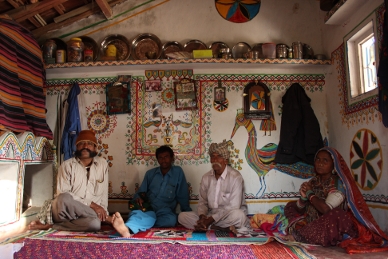
“Nothing in the world will last – it is but a two day fair” sings Mura Lala Fafal, drawing inspiration from the Sufi traditions of Sant Kabir and Abdul Lateef Bhita’i. He is accompanied on the Jodiya Pava (double flute) by his nephew Kanji Rana Sanjot. Kanji taught himself to play and make his own flutes after hearing the music on the radio. Mura and Kanji are Meghwals, a pastoral Dalit community that lives on the edge of the Great Rann of Kutch, in the Western Indian state of Gujarat. They are both daily wage labourers and subsistence farmers in an arid zone. The film is a a two day journey into the music and every day life of this uncle-nephew duo, set against the backdrop of the Rann.

Kanji and Murra with Kanji's family

The Great Rann of Kutch is a vast salt marsh/desert that separates India and Pakistan. Before the Partition the Meghwals moved freely across the Rann, between Sindh (now in Pakistan) and Kutch. The music and culture of the region is a rich tapestry of many traditions and faiths, an affirmation of the syncretic wisdom of the marginalised comunities that live in this spectacular and yet fragile area.